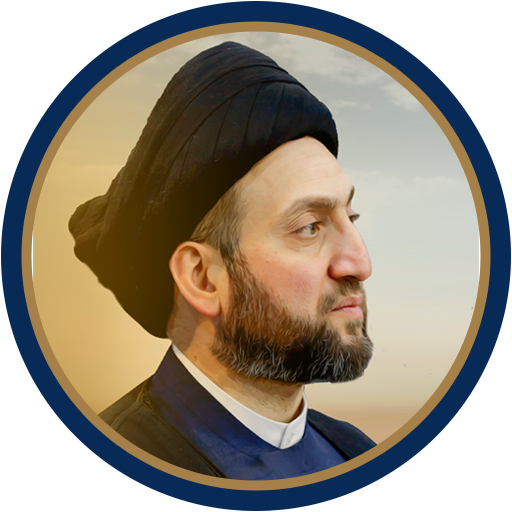

Sayyid Al-Hakeem: National Balance, Dialogue, Economic Diversification Paths to Strengthen Iraq's Stability, Protect Interests
As part of Baghdad Diwan events, His Eminence Sayyid Al-Hakeem, Head of the National State Powers' Alliance, met a large gathering of political and social elites from all Iraqi components, expressing happiness at Iraqis coming together on more than one occasion to discuss their national concern, exchange views on their country's paths, listen to visions, and then search for common solutions.
H.E. explained that the region is living in a state of anticipation of a devastating war that could be harder than the two previous wars, or of an agreement that spares it further escalation, praising the steadfastness of the Iranian people in facing challenges. H.E. explained that the war on Iran cast its shadows over the elections in America and in the Israeli entity, in addition to the role of the economy in these results, which was affirmed by the positions of government leaders in the United States of America.
H.E. explained the efforts of the region's countries, including Iraq, to avoid war and restore stability, and to seek solutions that could be acceptable and satisfactory to all parties.
H.E. regarded the end of the International Coalition's missions in Iraq as a message of recovery, calling for sending messages of reassurance among Iraqi components and removing all forms of concern through equations that reassure everyone. H.E. stressed the establishment of security and constant readiness to confront terrorism, warned against terrorism's attempts to prove its presence, and called for proceeding with the project of addressing weapons outside the framework of the state according to the agreed timelines, with the measure covering everyone who fits this description, expressing optimism that this task will conclude through dialogue and understanding.
H.E. explained the importance of managing Iraq's interests according to the principle of balance, regarding balance as Iraq's destiny that everyone must take into account, and affirmed that problems can be addressed but cannot be reduced to zero, only alleviated as much as possible. H.E. also called for distinguishing between freedom and the right of expression on one hand and infringing on others' privacy on the other, explaining that freedom is accepted and guaranteed as long as it does not harm others, their freedoms, and their persons.
H.E. stressed diversifying oil export outlets, regarding it as a strategic necessity through a network of pipelines delivering Iraqi oil to ports on the Mediterranean and Red Seas. H.E. called for adherence to the entire Constitution without selectivity, because it was written to take into account the interests of all, with the importance of accepting the interpretation of the competent authority in matters of disagreement when understanding the Constitution's articles and wording, in addition to adding constitutional articles and legislating important strategic laws such as oil and gas and the Federation Council, stressing the use of important laws to strengthen Iraq's unity.
Sayyid Al-Hakeem explained that parliamentary systems require parliamentary blocs to enjoy important relations with everyone, through which a bloc's role and influence grow, praising Iraq's openness to its regional surroundings and the easing of the atmosphere with the region's countries, and calling for taking the region's events into account when arranging priorities and ambitions of the Iraqi state.
Sayyid Al-Hakeem stressed the importance of decentralization as a constitutional reality, warning of desires for monopolization and poor local management that led to the decline of the principle of decentralization, and renewed support for holding local elections on time. H.E. explained that the Constitution preserves the principle of separation of powers and the independence of each authority from the other, calling for accepting the outcomes of democracy.
H.E. explained the government's orientation toward maximizing its revenues, especially in a phase of financial scarcity and declining revenues, calling for addressing problems between the Center and the Region and expressing confidence in the wisdom of the Kurdistan Region's leaderships in overcoming the crisis. H.E. explained that Iraqi Kurdistan's stability is an important part of Iraq's stability, calling for showing flexibility to reduce points of disagreement among all parties, pointing to the importance of eliminating social crises and confronting any inflammatory discourse on sectarian or national grounds, and calling for balance between safeguarding freedoms and criminalizing incitement discourse.


